The Monograph of Haute Finissage
Finissage is not mere decoration. In classical horology, manual polishing removes micro-burrs, prevents microscopic oxidation, and reduces frictional drag across decades of continuous operation. Here is how Aethel preserves four vanishing arts.
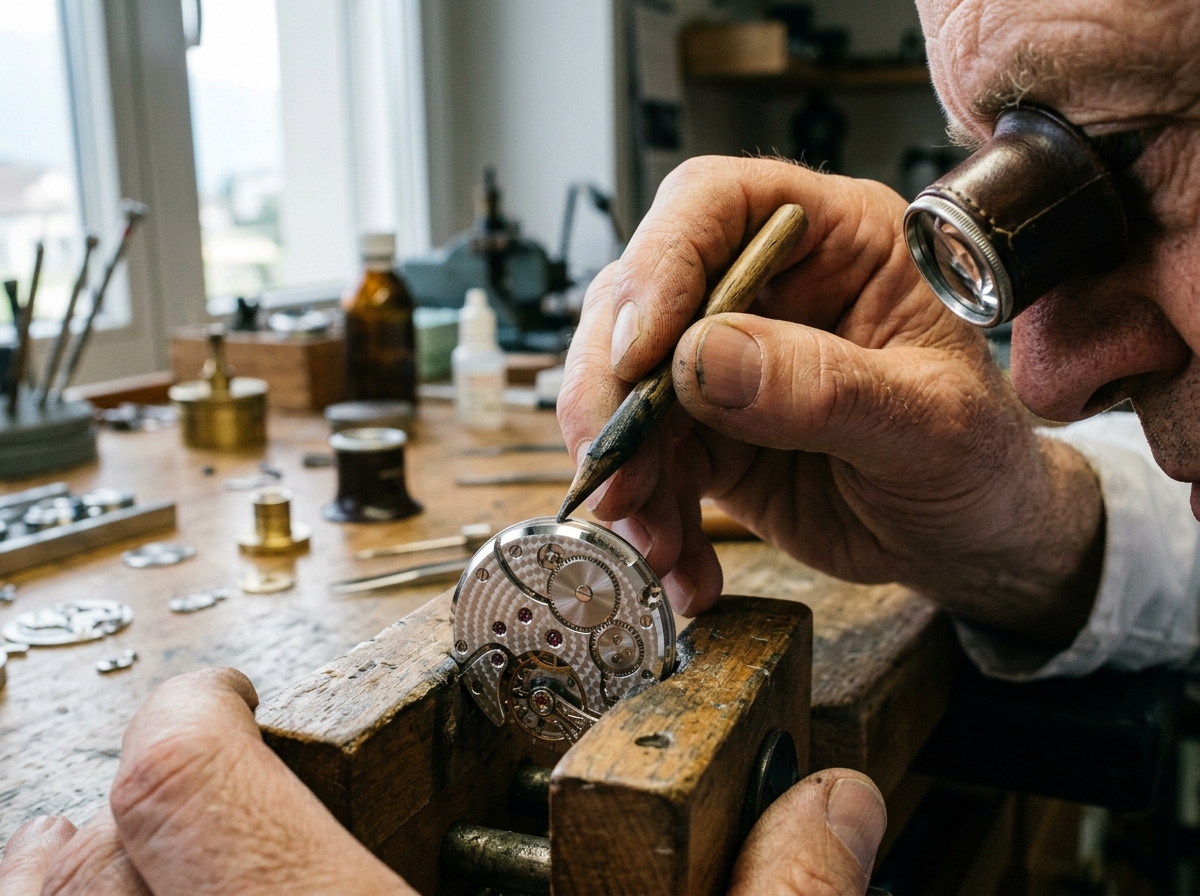 L'Anglage Main & Angles Rentrants
Hand-Chamfering & Internal Angles
“A machine can mill a line; only a watchmaker with a wooden peg can teach steel how to reflect the room.”
Where modern computerized machines can only leave rounded fillet radii, a human hand using needle files, carborundum stones, and gentian wood sticks can carve a crisp interior vertex that joins two bevels at a pinpoint junction. A single bridge can take upwards of 18 hours to file, burnish, and mirror-polish.
- Swiss needle files
- Degreasing carborundum stones
- Dried gentian wood pegs
- Fine diamond polishing lapping paste
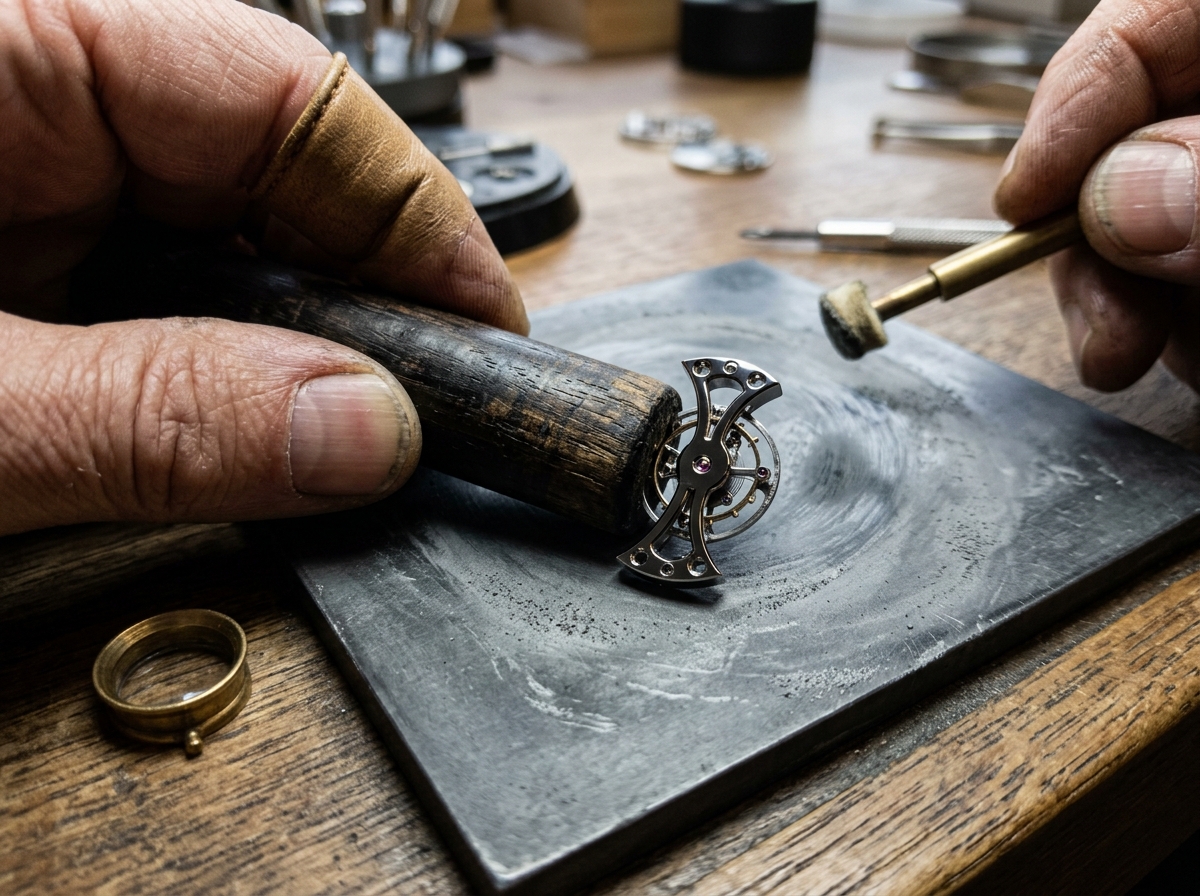 Le Poli Noir ou Poli Bloqué
Black Mirror Polish
“Black polish is optical silence. It either drinks the light entirely or returns it whole.”
Achieved by rubbing the steel part against a perfectly flat plate of zinc or tin charged with microscopic diamond powder. The movement must be circular and figure-eight, guided purely by the sensitive pressure of the watchmaker's fingertips. Any speck of dust will ruin the surface, forcing the artisan to start from zero.
- Pure zinc polishing laps
- 0.5-micron diamond compound
- Elder pith wood for cleansing
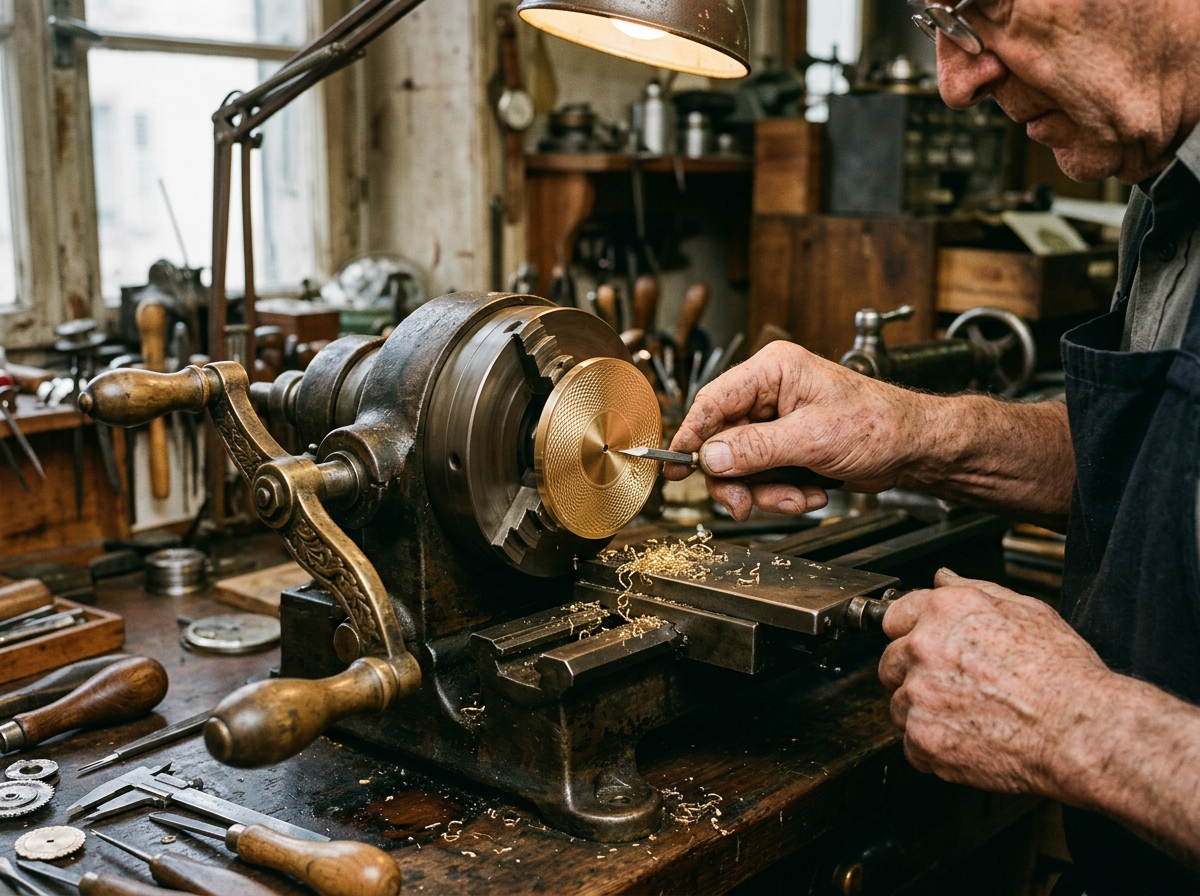 Le Guillochage au Tour Manuel
Straight-Line & Rose Engine Guilloché
“The engine does not move itself; it is an amplifier of the artisan's pulse.”
The rose engine lathe is powered entirely by hand cranks. One hand turns the rotational drive while the other delicately guides the cutting chisel against the dial plate. The slightest irregularity in breathing or cadence will telegraph as a visible flaw across the pattern.
- 1912 Straight-line engine
- 1898 Rose engine
- Carbide gravers ground to 60°
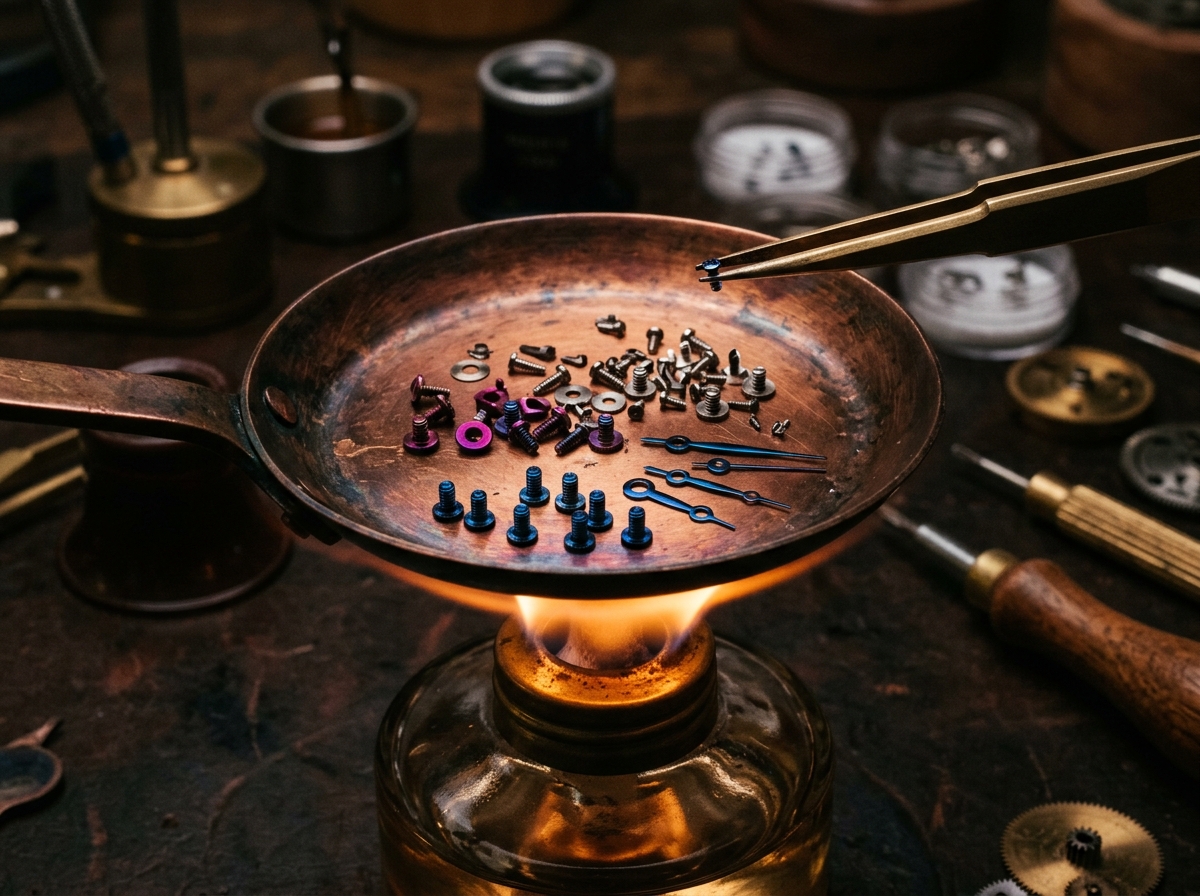 Le Bleuissement Thermique
Thermic Flame Bluing
“A second too late and the blue turns grey. Perfection lives within a five-degree window.”
Unlike chemical galvanic coatings that chip or fade, thermal bluing is an atomic transformation. The polished steel screw is set into fine brass filings or on a copper tray heated over a flame. As the temperature rises through straw yellow, purple, and magenta, it reaches peacock blue at exactly 295°C and must be instantly quenched.
- Copper heating tray
- Alcohol spirit lamp
- Hard brass tweezers
- Quenching oil
The Anatomy of an Interior Angle: Machine vs. Hand
When two chamfered edges meet at a concave angle inside a bridge, a milling bit can never produce a sharp point because circular drill heads always leave a radial radius. A true interior angle requires a watchmaker with steel needle files to cut a razor vertex by hand, then burnish it with fine gentian wood and diamond paste.