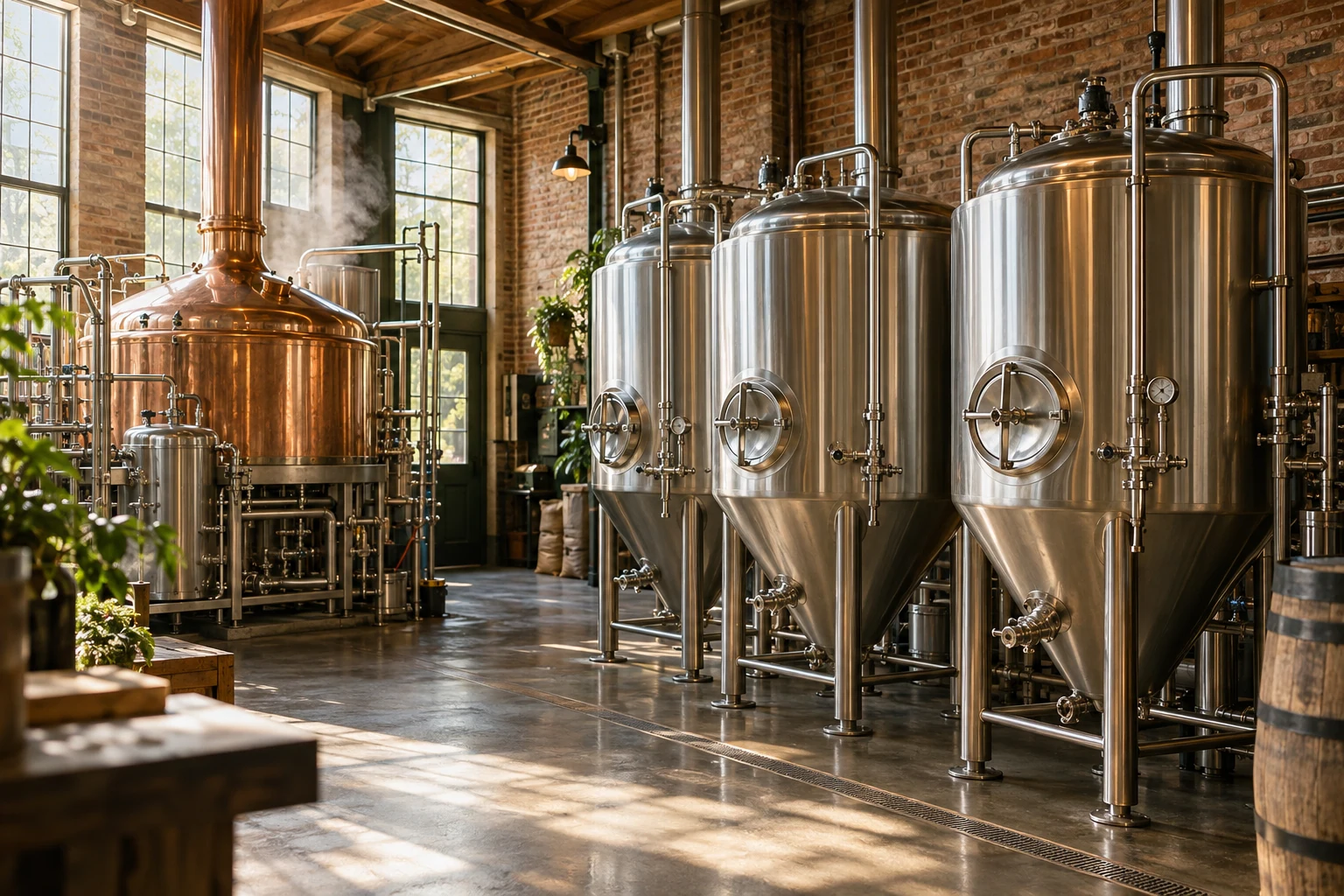
The Taproot Brewing Co. brewhouse — 7-barrel craft brewery in Portland, Oregon

Started in a garage.
Still going deep.

In the winter of 2017, Maya Rodriguez and Dev Chen converted a two-car garage in SE Portland into a 5-gallon homebrewery. Neither of them had brewed professionally. Maya had a degree in computer science and Dev had a product management job he was quietly growing to resent. What they had was 40 pounds of pale malt, a secondhand kettle, and a spreadsheet of recipes.

The first batch was a West Coast IPA. It was too bitter, slightly under-carbonated, and completely unbalanced. They drank every can anyway. By the third batch it was good. By the twelfth it was great. By 2019, they'd signed a lease on a 2,000-square-foot industrial space on SE Division and ordered a 7-barrel brewhouse from a closing brewery in Eugene.

How we brew.

Local first

We source malted barley from Mecca Grade Estate in Madras, OR. Our cascade and centennial hops come from a family farm in the Willamette Valley. We use Oregon water. We pay local prices, not import prices.

No shortcuts

Lagers cold-condition for six weeks minimum. Our saison ferments warm and bottle-conditions for two weeks. Dry hopping happens twice, sometimes three times. If it takes longer to do it right, it takes longer.

The honest pint

We don't make beer we wouldn't drink ourselves. Our session beers are genuinely sessionable — not watered-down IPAs rebranded as 'easy-drinking.' Our stout is as dark as it looks and as thick as it pours.

The people.

Maya Rodriguez

Co-Founder & Head Brewer

Maya spent 8 years as a software engineer before brewing took over her weekends, then her evenings, then her life. She studied brewing science at Oregon State, apprenticed at Deschutes in Bend, and brought that precision back to Portland. She runs the brewhouse, writes every recipe, and still insists on hand-labelling the first batch of every new beer.

Speciality: West Coast IPAs, Saisons, Experimental

Dev Chen

Co-Founder & Operations

Dev handled product at a fintech startup for a decade before Maya dragged him into the garage. He's the reason the taproom doesn't overflow with hop pellets and the website doesn't look like it was designed in 2009. He runs the business side, manages the shop, and brews the occasional lager — slowly, methodically, the way he does everything.

Speciality: Lagers, Stouts, Barrel-aging program

Priya Nair

Assistant Brewer

Priya joined as employee #3 after homebrewing sours in her apartment for four years. She manages the kettle-sour program and our small-format R&D batches. Her Berliner Weisse has won three regional awards. She's working on a wild-fermented farmhouse ale using foraged Oregon yeast that we hope to release in 2027.

Speciality: Sours, Wild fermentation, Wheat beers

The process.

Stainless fermentation tanks in the Taproot brewhouse — our 7-barrel brewing setup on SE Division
Step 01

Mash

Malted grain meets hot water in our 7-barrel mash tun at a precisely controlled temperature — usually 148–152°F for our ales. The enzymes in the malt convert starches to fermentable sugars over 60–90 minutes. This is where the beer's body and sweetness are determined.

Step 02

Lauter & Sparge

We drain the sweet wort from the grain bed through a slotted false bottom, then rinse the grain with hot water to extract remaining sugars. The spent grain goes to a local farm as cattle feed — we waste nothing.

Step 03

Boil

Wort boils for 60–90 minutes. We add hops in stages: bittering hops at the start for IBU, flavour hops at 10–15 minutes, and aroma hops in the final minutes or after the heat is off. Different hop varieties give us pine, citrus, tropical, floral, or earthy notes.

Step 04

Cool & Pitch

A plate chiller cools the wort rapidly to pitching temperature — around 68°F for ales, 52°F for lagers. We transfer to a conical fermenter and pitch our house yeast. Different yeast strains contribute different character: clean and neutral for IPAs, fruity and spicy for saisons.

Step 05

Ferment

Primary fermentation takes 5–10 days. We monitor temperature, gravity, and pH daily. Our saison ferments warm at 80°F for maximum yeast expression; our lager ferments cold at 50°F and conditions for six weeks. Patience is the ingredient we refuse to cut.

Step 06

Can & Package

We cold-crash, filter lightly (or leave hazy, depending on the style), and package on our 4-head canning line. Every can is purged with CO₂ before fill to minimise oxygen pickup. Beer is cold-room-stored until it ships. Our turnover is fast — we don't warehouse beer.

Sustainability.

We send spent grain to Glendale Farm in Tualatin — about 800 pounds a week that becomes cattle feed instead of landfill. We recycle 100% of our canning line waste water through a grey-water system. Our taproom lights are 100% LED and we buy carbon offsets for all freight shipping.

We're working toward B Corp certification. We're not there yet — the brewing industry's footprint is significant and we won't pretend otherwise — but we're tracking our numbers and publishing them annually. The 2025 sustainability report is linked in our footer.